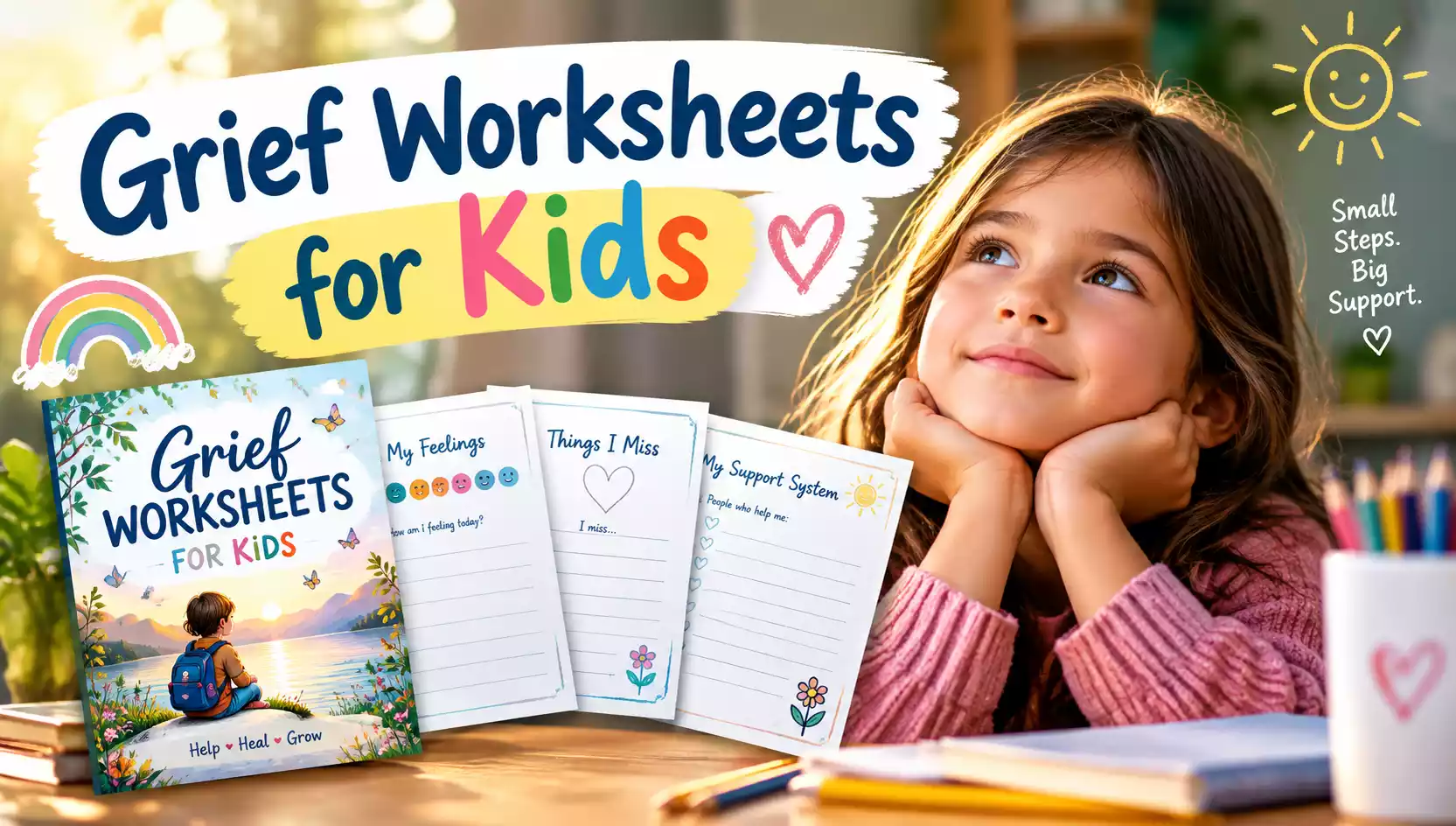
Grief Worksheets for Kids can help children express difficult feelings after a loss. Explore age-appropriate tools, tips, and support resources for kids and teens.
When a child loses someone they love, they often don’t have the words for what they’re feeling. Grief Worksheets for Kids can help bridge that gap. They give children a simple, low-pressure way to express emotions that feel too big to say out loud.
For a parent, teacher, or counsellor supporting a grieving child, these tools can open a conversation that might otherwise never start.
Children grieve differently than adults. A child might seem fine one moment, then suddenly cry, act out, or ask the same question about death over and over. This is normal. Kids often process grief in short bursts, moving in and out of sadness while still wanting to play.
Worksheets and simple guided activities work well here because they don’t demand a long conversation. They meet a child where they are, for as long as they can sit with it.
In this article, we’ll look at how grief worksheets can support a child through loss, what to look for in a good worksheet, how Grief Worksheets for Teens differ from those made for younger kids, and how a broader grief workbook.
What Are Grief Worksheets for Kids?
Grief Worksheets for Kids are guided activities, usually with drawing prompts, simple questions or feeling charts, designed to help children express emotions they can not easily put into words. Rather than facing an abstract, scary topic. A child gets one small, manageable task at a time.
Simple Prompts
Easy questions a child can actually answer
Safe Expression
A way to share feelings without pressure to talk
Routine
A predictable activity that feels safe to return to
Connection
A shared activity between child and trusted adult
Worksheets also give the adult in the room something concrete to work with. Instead of asking “how are you feeling?” and getting a shrug, you can sit together and fill in a page. That shared activity often opens up conversation naturally.
How Grief Shows Up Differently in Children
Grief in children does not always look like sadness. It can show up as anger, trouble sleeping, clinginess, or a drop in schoolwork.

Younger children may not fully understand that death is permanent, and may ask when the person is “coming back.” Older children and teens may withdraw or seem unaffected on the surface, while struggling privately.
Every child grieves differently: Two siblings can react to the same loss in completely different ways. There is no single “right” reaction to watch for.
Understanding these differences matters. A worksheet designed for a five-year-old looks very different from one written for a fourteen year old.
Age-appropriate language and format make a real difference in whether a child engages with it at all.
What Age Groups Need Different Approaches
| Age Group | What Tends To Help |
|---|---|
| Ages 4–7 | Drawing, simple feeling charts, short guided questions |
| Ages 8–12 | Writing prompts, memory pages, “what helps me feel better” lists |
| Teens (13+) | Journaling prompts, coping strategy worksheets, space for private reflection |
| Parent / Caregiver | Guides on how to talk about death, answer hard questions honestly |
Younger children usually need an adult sitting with them to guide the activity. Teens often prefer working through a worksheet privately, then choosing what, if anything, to share.
Grief Worksheets for Teens: What is Different
Teenagers process loss differently than younger kids. They understand death as permanent, but they may also feel pressure to “be strong” for family, or worry about seeming different from friends.
Grief Worksheets for Teens tend to focus less on drawing and more on private journaling, identifying triggers and naming complicated emotions like guilt or anger.
Teens often prefer privacy: A teen may not want to talk about grief face-to-face, but might open up more through writing. A worksheet gives them space without forcing conversation.
Good worksheets for this age group also cover topics young children do not usually face yet, like changed family roles, unresolved relationships or grief that gets pushed aside because of school and social pressure.
A Resource for the Adult Supporting the Kids
It’s worth being clear here: not every “grief worksheet” resource is written directly for young children to complete alone. The Grief Worksheets workbook by Social Support and Counselling.
Good to know: This particular workbook is best suited for parents, caregivers, and counsellors looking for structure and language to support a grieving child, or for teens old enough to work through it directly. It is not a picture-based activity book for very young children.
If you’re a parent trying to understand grief stages so you can talk to your child more confidently or a counsellor looking for ready made prompts to adapt for younger clients, this kind of workbook can still be genuinely useful.
Printable JPGs
Two zip files of single worksheets you can print
Grief Worksheets for Teens vs. Grief Worksheets for Kids
The core difference comes down to independence and language. Younger children need visual, guided activities done together with an adult.

Teens generally want independence, privacy, and worksheets that treat them like they can handle complex feelings, not simplified ones.
| Feature | Grief Worksheets for Kids | Grief Worksheets for Teens |
|---|---|---|
| Format | Drawing, simple charts, short prompts | Journaling, reflection questions |
| Adult Involvement | Usually done together | Often done independently |
| Language | Simple, concrete words | More complex emotional vocabulary |
| Common Topics | Feelings, memories, routines | Identity changes, triggers, coping strategies |
Simple Ways to Support a Grieving Child or Teen Right Now
- Answer questions honestly, using simple and clear words like “died,” not confusing phrases like “went to sleep”
- Keep normal routines where possible, since predictability feels safe
- Let them see you grieve too, in a calm way, so they know feelings are okay to show
- Give teens privacy and space, rather than pushing them to talk before they’re ready
- Watch for signs a child or teen may need extra support, like ongoing withdrawal or trouble functioning at school
There’s no rush. A child may ask about the same loss for months or years. A teen may go quiet for a while before opening up. Both are normal.
When to Seek Extra Support
Most children and teens grieve and adjust over time with support from family. But sometimes more help is needed than a parent alone can give.
Reach out if needed: If a child or teen talks about wanting to hurt themselves, shows extreme changes in behaviour, or seems unable to function for a long period, contact a doctor, school counsellor, or child mental health professional. In Australia, Kids Helpline is free at 1800 55 1800. In the US, contact 988 or a paediatrician for guidance.
Where This Workbook Can Fit In
If you’re a parent, caregiver, or counsellor wanting a structured resource to draw language and worksheet ideas from while supporting a grieving child or teen, this workbook is worth a look.
Supporting a grieving child or teen is not about having perfect words. It is about staying present, being honest and giving them safe ways to express what they feel.
Worksheets and guided activities are just one tool among many; what matters most is the steady presence of a trusted adult who keeps showing up.
FAQ:
What age can grief worksheets be used from?
Simple feeling-based activities can work from around age 4, usually with an adult guiding the child. Writing-based worksheets tend to suit children aged 8 and up, while teens can often work through prompts independently.
How do I know if my child needs professional help with grief?
Watch for signs like ongoing withdrawal, trouble sleeping or eating for weeks, a sharp drop in school performance, or talk of self-harm. If any of these appear, speak with a doctor, school counsellor, or child psychologist.
How are grief worksheets for teens different from those for younger kids?
Worksheets for teens usually focus on journaling and private reflection, while worksheets for younger kids rely more on drawing and simple guided questions done together with an adult.
Is the Grief Worksheets workbook made specifically for young children?
Not directly. It’s designed mainly for teens and adults, including parents and counsellors. It’s most useful for an adult looking for structure and language to support a grieving child, or for teens working through it themselves.
What should I say to a young child about death?
Use clear, honest language rather than confusing phrases. Simple, age-appropriate explanations help children understand without added fear or confusion.
Is it normal for a teen to seem unaffected by a loss?
Yes. Teens sometimes appear unaffected on the surface while struggling privately. This doesn’t mean they’re not grieving, it often just means they process it differently than younger children.